


Views: 104 Author: Site Editor Publish Time: 2026-01-09 Origin: Site


A customized TFT LCD module allows OEMs to adapt display size, interface, brightness, touch, and mechanical structure to fit specific products and operating environments. However, customization also introduces trade-offs in cost, lead time, certification, and long-term supply stability. Understanding these factors early helps OEMs avoid redesigns, delays, and unexpected expenses.
 Standard off-the-shelf TFT displays often fail to meet real-world product requirements. OEMs typically request customization when they need:
Non-standard screen sizes or aspect ratios
Higher brightness or outdoor readability
Specific interface compatibility
Integrated touch solutions
Extended operating temperature ranges
Unique mechanical mounting or housing constraints
Customization ensures the display works as part of the system, not as a compromise.
Custom TFT modules allow OEMs to match the display exactly to the product enclosure.
Considerations:
Diagonal size vs usable viewing area
Resolution impact on MCU or SoC performance
Unusual aspect ratios (e.g., 3:1, 5:1) may increase NRE cost
OEM Tip:
Higher resolution is not always better—balance clarity with processing power and cost.
Brightness customization is common in industrial and outdoor devices.
Options Include:
Standard brightness (300–500 nits)
High brightness (800–1000 nits)
Sunlight readable (1000–1500+ nits)
Additional optical enhancements may include:
Anti-glare or anti-reflective coatings
Optical bonding
Transflective TFT panels
Each upgrade improves readability but impacts power consumption and thermal design.
Interface compatibility is critical for seamless system integration.
Common Interfaces:
RGB (TTL) – Simple but limited for high resolution
LVDS – Stable for industrial environments
MIPI DSI – Compact and power-efficient
SPI – Low-speed, cost-sensitive devices
eDP – High-resolution and longer cable support
OEM Tip:
Always confirm signal voltage levels, pin definitions, and EMI tolerance early in the design phase.
Touch integration often defines the user experience.
Touch Options:
Capacitive touch (PCAP)
Resistive touch (4-wire / 5-wire)
Cover glass shape and thickness
Glove or wet-touch support
Customization may include:
Driver IC selection
Interface (I²C / USB)
Optical bonding between TFT and touch panel
Mechanical mismatch is a common cause of late-stage redesigns.
Customization Areas:
Bezel width and shape
Mounting holes and brackets
FPC direction and length
Connector position
OEM Tip:
Request mechanical drawings (2D + 3D) before freezing the design.
Industrial and automotive products often require extended temperature support.
Typical Ranges:
Commercial: 0°C to 50°C
Industrial: -20°C to 70°C
Extended: -30°C to 85°C
Customization may involve:
Special liquid crystal materials
Reinforced backlight design
Enhanced aging and vibration testing
Customized backlight designs impact both performance and longevity.
Key Metrics:
LED current and brightness curve
Power consumption under max brightness
Backlight lifetime (typically 30,000–50,000 hours)
OEMs should evaluate brightness vs lifetime trade-offs carefully.
Customization introduces non-recurring engineering (NRE) costs.
Common Cost Components:
New tooling or molds
Custom FPC design
Firmware or driver tuning
Certification testing
Cost Control Tip:
Reuse existing panel platforms whenever possible to reduce NRE and lead time.
Custom TFT LCD modules typically require:
Development time: 4–8 weeks
Sample validation: 2–4 weeks
Mass production lead time: 6–10 weeks
MOQ may vary based on customization level, especially for:
Custom glass sizes
Special backlight designs
Unique interfaces
OEMs targeting regulated markets should confirm support for:
RoHS / REACH
CE / FCC (system-level impact)
Automotive or medical standards (if applicable)
Display suppliers should provide compliance documentation early.
A customized display is a long-term commitment.
OEMs Should Ask:
Is the panel guaranteed for long-term supply?
Are alternative panels available?
What is the end-of-life (EOL) policy?
This avoids costly redesigns mid-product lifecycle.
❌ Underestimating thermal impact of high brightness
❌ Choosing uncommon interfaces without backup options
❌ Skipping optical bonding for outdoor use
❌ Ignoring long-term panel availability
❌ Finalizing mechanical design too late
✔ Define application environment clearly
✔ Confirm interface and signal compatibility
✔ Validate brightness under real conditions
✔ Review mechanical drawings early
✔ Evaluate total cost, not just unit price
✔ Plan for long-term supply
Toroson provides professional display driver solutions with a focus on industrial and commercial markets. With strong OEM/ODM capabilities, technical support, and a stable supply chain, they cater to system integrators and B2B buyers worldwide. Their products are developed with attention to quality control and compliance with international standards, ensuring long-term reliability for global projects.
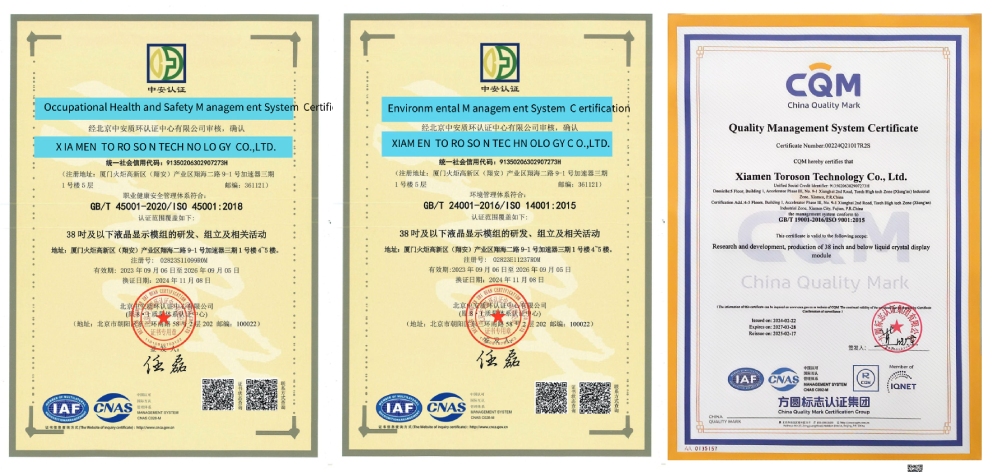
Established in 2014, Xiamen Toroson Technology Corporation Limited has been a trusted leader in the manufacturing of TFT LCDs, TFT LCMs, Touch Screens, Controller Boards, and other related electronic components.
Based in Xiamen, China, with additional offices and warehouses in Shenzhen and Hong Kong, Toroson is strategically positioned to provide superior logistics and service to clients worldwide. Toroson's brother company Viete has been an authorized distributor of Innolux for small to medium-sized TFT LCD/LCM and FOG products since 2005.
A customized TFT LCD module offers OEMs the flexibility to build better, more reliable products—but only when customization decisions are made strategically.
By evaluating optical performance, interfaces, mechanical design, reliability, and lifecycle planning early, OEMs can reduce risk, control cost, and accelerate time to market.


