


Views: 104 Author: Site Editor Publish Time: 2026-05-14 Origin: Site


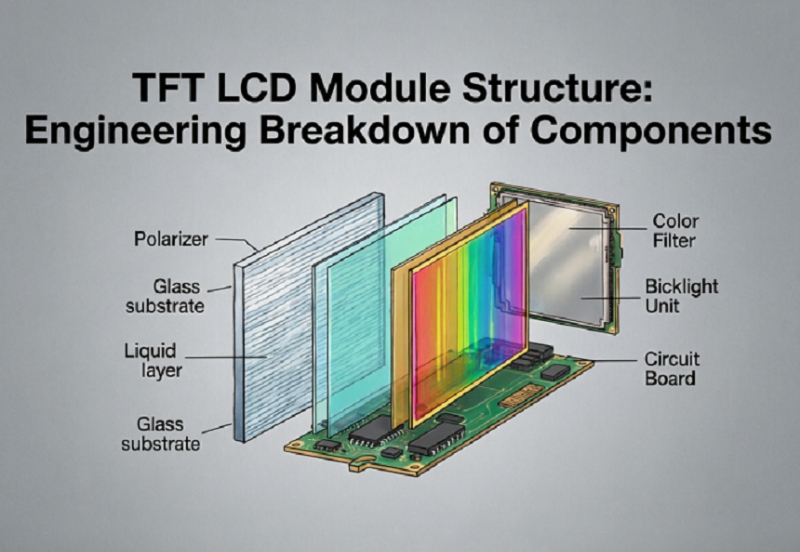
A TFT-LCD module consists of a layered stack integrating an a-Si (Amorphous Silicon) TFT glass substrate, liquid crystal layer, color filter, polarizers, and a backlight unit. System integrators must verify the thermal expansion coefficients and electrical isolation of these layers to ensure operation within the specified -30°C to +85°C range. Factory-sealed modules maintain strict environmental tolerances, ensuring the Active Area remains free from contaminants and optical misalignment.
The assembly of an industrial-grade display relies on precise mechanical alignment of the optical stack. Each layer serves a specific function in light modulation and signal transmission.
Backlight Unit (BLU): Provides the light source via high-efficiency LED arrays. Standard industrial units are rated for 50,000 hours of Backlight life to half-brightness.
Diffuser & Prism Sheets: Redistribute light from the LEDs to ensure uniform luminance across the entire display area.
TFT Glass Substrate: Contains the pixel-switching transistors that control the state of individual liquid crystals.
Liquid Crystal Layer: Modulates light based on the voltage applied through the LVDS interface or TTL signaling.
Color Filter: Defines the sub-pixel structure to produce the NTSC color gamut required for accurate visual output.
Polarizers: Filter light waves to create the image visible to the end-user.
Proper integration requires an understanding of how these components influence performance metrics such as contrast ratio and response time.
Component | Engineering Function | Performance Metric |
LED Array | Illumination source | 30,000 - 50,000+ MTBF |
Polarizer | Light polarization | 1000:1 Contrast Ratio |
TFT-Glass | Signal/Pixel control | Response Time (Tr+Tf) < 25ms |
Driver IC | Data conversion | 6-bit or 8-bit color depth |
Industrial applications prohibit the use of open-cell or non-hardened displays due to the risk of environmental degradation. Original Innolux factory-packaged modules offer three distinct advantages for long-term stability:
Contamination Control: The internal stack is assembled in a Class 1000 cleanroom, preventing dust particles from being trapped between the polarizer and the liquid crystal layer.
Mechanical Tensioning: The metal bezel provides necessary structural rigidity, preventing flex-induced pressure points that cause "mura" or light leakage.
Thermal Dissipation: Factory-integrated thermal interface materials (TIM) and heat-sinking frames are calibrated to the specific wattage of the backlight, preventing thermal runaway.
For more information on our quality control processes and authorized supply chain, read more about our organization in our About Us section.
Q1: Can the backlight unit be replaced if it fails before 50,000 hours?
In industrial Innolux modules, the backlight is integrated into the structural assembly. Replacing it individually is not recommended as it voids the mechanical warranty and compromises the display's optical alignment. We recommend unit-level replacement for reliability.
Q2: Does moisture ingress affect the internal layers of a TFT-LCD module?
Yes. High humidity can cause corrosion on the FPC (Flexible Printed Circuit) and oxidation of the internal metallic traces. For outdoor or high-humidity environments, we recommend IP65-rated enclosures with a protective cover glass and optical bonding.
Q3: How do I verify if a module is a genuine factory-sealed unit?
Verify the Innolux serial number against our database. Genuine modules feature laser-etched barcodes on the rear metal housing, which include the manufacturing date, lot code, and electrical testing parameters specific to that unit.


